| Galerie Peter Herrmann | - | Ancient Art from Africa | ||
 |
 |
 |
||
 |
 |
|---|
| Thermoluminescence - Expertise | Vessel |
 |
Benin, Nigeria |
| Edited in the net since april 2026 |
 |
|
|---|
| Description |
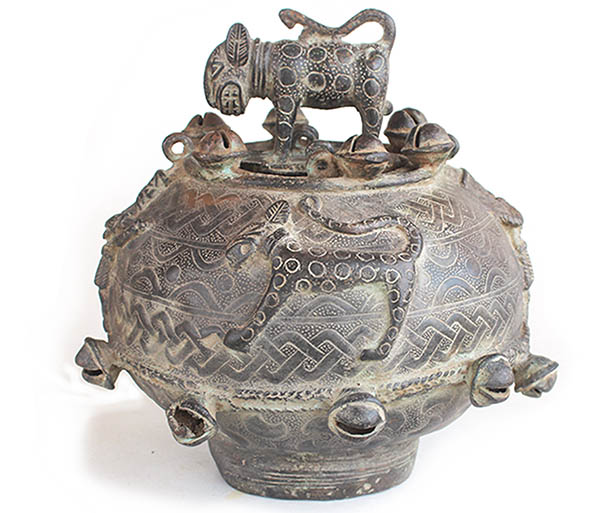
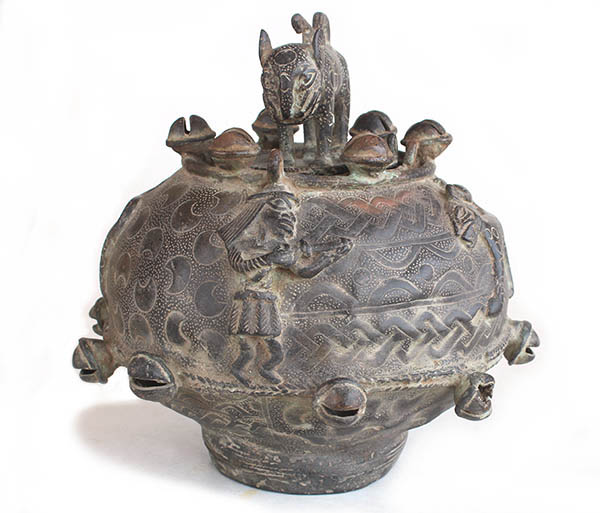
Dating from around 1800, this vessel predates the period – very roughly speaking – around 1850 when metals became more affordable in West Africa, a development linked to ships and scrap metal. Prior to this, castable metal was extremely expensive. It was imported from Europe in the form of special alloys. As early as 1900, Felix von Luschan, director of the Berlin Museum of Ethnology, was conducting research in the Port of Hamburg into the volume and nature of exports, the predominant origins of which were likely in Tyrol and what is now the Saarland. The Fuggers were already involved in the trade to Benin through sales to the Portuguese. Before the 16th century, metal alloys from West Asia were transported across the Sahara. The coloured castings – as the bronzes are correctly termed – reached the Ibo people in what is now Nigeria for further processing around the 7th or 8th century. There are even tentative indications that China was involved in the metal trade in Africa long before the 16th century. The fact that has recently been hyped by the press as a spectacular discovery – namely that Germany was involved in the production of the ‘Benin Bronzes’ and thus in the slave trade – is a product of woke-feminist strategies designed to demonstrate that they are actually doing something. This brief excursion through history is intended to illustrate why the value of the metals used for so-called lost-wax casting was an extremely expensive luxury that at times rivalled the price of gold. |
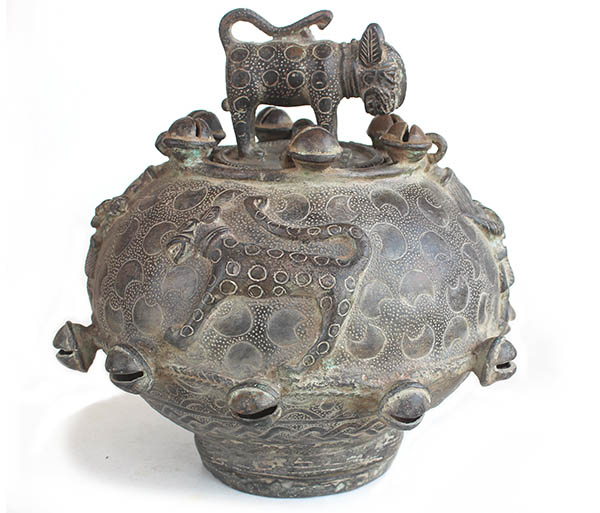 |
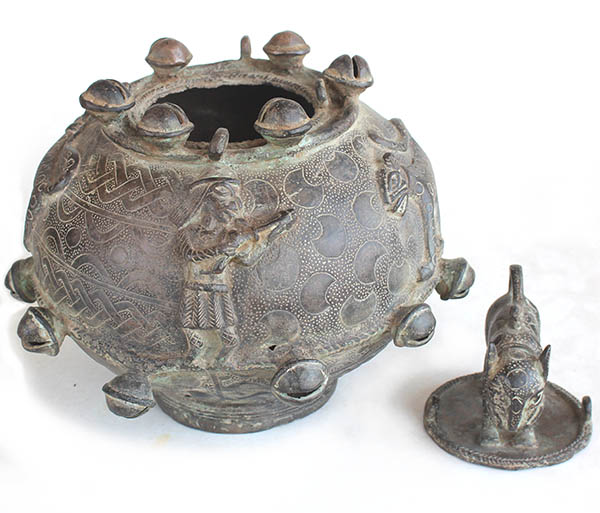
Portuguese and leopards are symbols of power and therefore hold great significance in Beninese mythology. European researchers do not know what connection they have to the contents stored in the vessel. The current cooperation between Germany and Nigeria focuses primarily on two areas of research: which receipts and invoices can be found in the old accounts. This is known as provenance research. From the perspective of Nigeria’s former monarchy, the focus is on which objects with museum provenance it is still possible to lay claim to in some way. This creates a point of scientific friction, because the receipts actually state that all these objects were purchased. So one remains on the surface with phrases and vague hints, rather than addressing what these strange, bell-like decorations on the vessel actually signify. Another important point to consider is that research into the subject matter – which is, of course, primarily a matter for Nigeria – is being influenced in an extremely negative way by the German side. Where funds flow, opportunism follows. Upon closer examination of the issue of restitution, one encounters extreme corruption. Originating from the German side, not the Nigerian. It is important to emphasise this. The decorative motifs typical of Benin culture bronzes – interlaced bands, notched circles and dots – have hitherto been taken for granted. Another interesting feature of this artefact is the four eyelets on the vessel and the two on the lid depicting a leopard. These indicate that the vessel was carried to an event and that the lid could be secured in place for this purpose. A hole has formed in the base of the vessel due to corrosion. Otherwise, there is no damage. |
 |
| Translated with DeepL.com |
|
 |