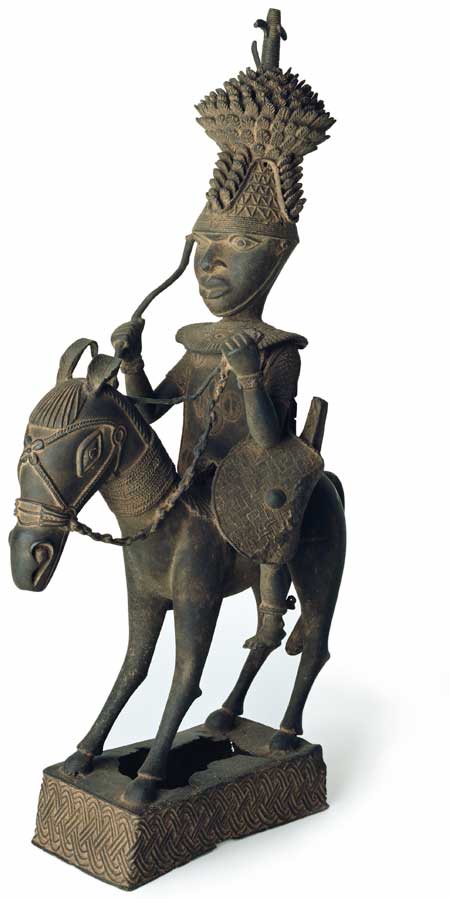
This object is the oldest of the three horsemen and the most graceful. The head covering is decorated with large quantities of parrot feathers, rendered with remarkable accuracy and painstaking care. The horseman sits loftily upon his steed, which, like its rider, exudes vibrancy and elegance. The overall result is a dynamic rendering of figures apparently captured in motion.
The identity of this and similar equestrian figures from Benin has been widely interpreted. In 1919, Luschan offered the first hypothesis: that the uncommon headdress and clothing indicated that the person depicted was a foreigner. Dark classified the figure more specifically, interpreting him as a Yoruba warrior, in large part because of the size of his horse. Fagg, on the other hand, argues that he is an emissary from an Emirate in northern Yoruba, basing his judgement on the figure's headdress. According to other researchers (Tunis, Karpinski), though, the bronze depicts a king of Benin. This argument is substantiated by the well-known American Benin researcher Paula Ben-Amos, who connects the horseman to Oranmiyan, the founder of the current dynasty (ca. 1200) who is said to have come from the Ife kingdom and introduced horses to Benin. Meanwhile, Nevadomsky advanced two other theories regarding a similar horseman: in the first, he argued that the figure represents the ruler of the Igala, Attah von Idah; in the second, that it represents Oba Esigie (ca. 1504-1550). (Dorina Hecht, 2008)
Meanwhile I was reading such a lot of nonsens from the above mentioned scientists, that it might be the best to say: we do not know anything about that rider. (Peter Herrmann, 2016)
Cp.:
Felix von LUSCHAN: Die Altertümer von Benin, Band 1-3, Berlin 1919, S. 174 und 297.
Philip DARK, W./ B. FORMAN: Die Kunst von Benin, Prag 1960, S. 50.
Paula Girshick BEN-AMOS: The art of Benin, London 1995, S. 54.
Barbara PLANKENSTEINER (Hg.): Benin. Könige und Rituale. Höfische Kunst aus Nigeria, Wien 2007, S. 449/ 450. |