 |
Columns | Dorina Hecht, April 2007 |
|
|
Exhibition |  |
|
 |
On the occasion of the exhibition "Bronzes from Ife and Benin" from February 3rd to April 14th 2007 in the gallery Peter Herrmann, Berlin |
|---|
| Discussion contribution with problem definition and comparison (by Dorina Hecht, Translation by Dan Hesslinger CdN) |
Bronzes from Ife and Benin are considered as one of the most advanced cultural treasures of Africa. The oldest bronzes are approximately 1000 years old and characterised by a masterful casting technology and an unusually sensitive realism. The discussion of the artistic value of the Benin bronzes begins for Europe in 1897 at the time of their discovery. At that time, a British military expedition conquered the kingdom of Benin. The palace and majority of the city burnt down. The governing monarch was sent into exile, and a colonial government was implemented. Over one thousand bronze sculptures were brought to England. By auctions they were sold to European and American museums and private collections which were created at that time. The history of the kingdom of Benin before that time is mainly known through oral traditions and plenty of assumptions. From 1938 on, the bronzes from Ife were found during excavation works. The historical context, in which the Ife bronzes were created, is even less known. |
 |
I
Supposedly, most of the sculptures were not for use, but intended for representative purposes at court. Their main function probably was to honour living or deceased kings, the documentation of palace scenes, or the tradition of historical events. However, it is questionable whether all Benin bronzes were made for the court as the objects exhibited were mainly found outside the palace.
This fact shows how important it is to consider the scarcely known context for the attempt of understanding - as far as it is possible. And this is the major problem of African art in general, and of the bronzes in particular. Which possibilities do exist for us to approach to a foreign culture - to art, which is hardly accompanied by any written sources, and whose contextual background is only to be found in oral traditions? By the example of subjects, which could be seen in an exhibition under the title "bronzes from Ife and Benin" from February 3rd to April 14th 2007 in the gallery Peter Herrmann, possibilities and difficulties of understanding are to be described. With approximately 70 subjects the gallery has assembled a large number of unknown bronzes of different age and has given the outstanding possibility to compare Ife and Benin bronzes. |
Some important ethnologists undertook some successful attempts of classification soon after their discovery in around 1900 and have thus created an important basis for the exploration of Benin culture. Ethnologists such as Felix von Luschan, then director of the Berlin museum of ethnology (Berliner Völkerkundemuseum), set the scientific foundation. Scientists as for example Bradbury, Dark, Fagg, and the Ife researcher Willett continued the research particularly in England in the 1960's and 70's. The numerous research studies of these years gave first interpretations, and attempt to see the art of Benin and Ife in an historical context on the basis of the few sources available. The few older sources existing are also from European hand, from Portuguese or Dutch men, which were in trade with Benin since the end the 15 th century, e.g. Dapper. Some of the younger of the important researchers are Paula Ben Amos or Armand Duchateau among others. The last of which exclusively supposes a royal culture and examines individual subjects always before the background of feudal structures. |
 |
In museums as the British Museum in London, the Völkerkundemuseum in Berlin, or the Völkerkundemuseum in Vienna, some of the objects, which first came to London after the
British military expedition in 1897, are on display. They were removed directly from the palace at that time and are therefore to be considered as authentic objects. Regarding all the other Benin bronzes from different centuries circulating on the art market, like e.g. those of the gallery, there is always some uncertainty. If they were not involved into the palace robbery, they are considered as objects with unknown origin. Their valuation is a lot less important, and their authenticity has to be proved by different methods. The main question is not the question of authenticity, but the question of the age of the bronzes. If the age could be determined, the question of authenticity would be void, at least as old bronzes are concerned. The only answer the military expedition gives is that the objects stolen on this occasion must have been produced before 1897. Otherwise, their context is just as unknown as the context of all the other objects on the market. |
 |
|---|
 |
At least two chemical-physical methods exist for the age determination: The first of which is the metallurgical examination and the second the thermal luminescence examination (TL). The gallery says the more relevant method was the TL examination - an experienced however not yet completely acknowledged method which helps to draw accurate conclusions to the manufacturing date from remains of the burnt centre of a founded sculpture. The TL examination together with style comparison, which is from the standpoint of art history, the best method of age determination, is used by the gallery Herrmann. It can hardly be determined at which time one used a certain style or how the Benin and Ife sculpture style developed because the same motifs were used for centuries and were changed only little by the artists who created the Benin sculptures.
Already in around 1900, von Luschan developed several theories concerning style analysis. |
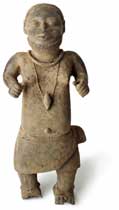
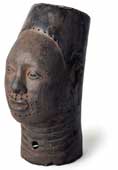
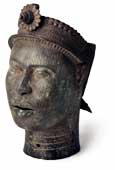
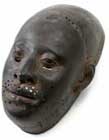
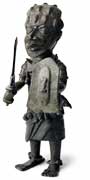
His theories are based on a decline or fall theory. Technology and formal quality of the bronzes would therefore reflect a decreasing quality level in the course of the centuries. On the basis of the exhibition, this thesis is only partially comprehensible, and cannot be proven. The oldest works exhibited, like the approximately 900 year old dwarf or two 700 and 600 year old heads as well as an Ife mask are of remarkable quality. - They are convincing because of their realistic physiognomy and individual expression, but also because they are masterfully thinly and evenly founded. Among the more recent objects there are some very characteristic ones, too, as the warrior with the crocodile leather helmet, which is of fine technical and formal quality. At present, some art historians like Eisenhofer doubt the decline or fall theory, and assume that the theory was related to justifications of the British colonisation of a realm which was said to have already been declining anyway. Accordingly, the British would have robbed a culture. |
 |
 |
Another theory is based on the chronology developed by Fagg and Dark, according to which the Benin bronze sculptures were strongly influenced by the casting art of the Yoruba city Ife from the 13th to 15th century. Their theory is likewise based on observations, that the realistic and sensitive representation is typical, both for the bronzes from Ife and for the early period of Benin art, what is therefore usually seen as a proof for the influence by Ife and the remarkable Ife style. |
A question is whether the bronze culture of Ife might be Benin? Did both cultures exist one alongside the other? Or perhaps, Ife bronzes were also founded in Benin, as Eisenhofer already suggested? A proof for this hypothesis of in Benin founded Ife style sculptures, and
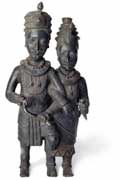
against von Luschans decline and fall theory might also be the 100 and 250 year old royal couples, in which both styles merge. Both, they show the sensitive realism, which often is assumed to characterize older works only, and the body modelling in Benin style. Realism has even been significantly developed, and both figures have clearly distinguished individual faces, which was hitherto unknown in Benin and Ife. The thesis of casting in Benin is underlined by a small head, on which typical signs of Ife heads can be seen. According to oral traditions, it represents an important Ife person, which is only vaguely known as "Moro". The head was founded in Benin in around 1880, and has been |
 |
|
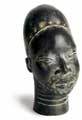 |
found in the Obaseki shrine. The experts' TL method later confirmed the age. The best-known bronzes from Ife are life large majestic heads, which are decorated with scars and supplements for royal crowns, and masks and may be some busts. Whole figures are not registered in literature. One exception is a sitting woman, which was discovered by Fagg, and is stylistically attributed to Ife (see: Franc WILLETT: Ife. Metropole afrikanischer Kunst, Bergisch Gladbach 1967, Tafel 8). Natives are said to have constantly polished with sand the sitting female sculpture for ritual purposes - to strengthen fertility of women - which is the reason for its today's smooth appearance. |
|---|
Two similarly sitting sculptures of the exhibition can likewise be used as proof against the theories explained above. At least one of which has been proven to be 700 years old - and has thus been created at the same time as a marvellous and elegant Ife head - however a lot less fine and less individually sculpted than the sculpture shown by Willet. Although small characteristics as the ears stylistically rather refer to Ife, it is otherwise sculpted in a strange and unusual roughness, which possibly points to a stylistic mixture. Nevertheless, they serve as good comparison examples and can help to enlighten hitherto unsolved questions. What appears to be coincidence at one figure turns out as an again and again returning design element on a more exact view: all three figures have in common one missing foot and missing hands. They are not reduced or otherwise lost; the figures seem to have been already cast without. At least, the sharp casting edges at the foot and hands of one figure refer to this assumption. If they were perhaps later equipped with wooden hands and foot, can only be speculated about. Apparently, these body parts were left missing in order to fix something |
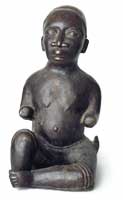 |
else at the sculpture, possibly some decoration elements as at Ife heads which were equipped with beads, hair and other decoration. The remarkable parallels suggest that these body parts were consciously not cast, but the sense and purpose of the missing parts are still unexplored. |
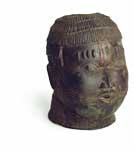 |
Behind most theories there still are large question marks, much has been gathered from oral traditions and nevertheless rests dominated by numerous assumptions. The important Benin researcher Paula Ben Amos gained most of its material in the 1960's via laborious field trips and collected traditions. Directly compared with the works of art some considerations might be doubted. A 16 th century head in a so-called Ibo hair style, a hair style of plaits in different levels , she does not regard as a trophy as usually but as a memorial head. According to her theory, as a sign of triumph, the head of a defeated king would have been cut off in order to give it to the bronze guild for its remodelling. This cruel handling would only have been used for particularly rebellious enemies and as a warning for its successor, to whom it would have been sent afterwards (see: Paula Girshick BEN AMOS: The art of Benin, London 1995, p. 26). |
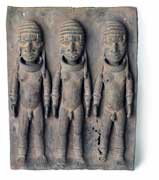
Here is a comparison with bronze plates interesting, on which figures in the same hair style are depicted. In the exhibition there are six plates, on which the protagonists carry this "Ibo hair-style". They always appear as pages, chiefs, warriors or other assistants of the king. Usually they are represented by coral necklaces as members of the royal palace of high standing. The frequency and context, in which this hair-style can be found, proof that these
are not pictures of opponents or enemies but of members of the court. Maybe Willet is even right who assumed the head to be a memorial head of a Benin king.
If this hair-style would though signify Ibos, this could either mean that the Ibos co-operated with the Edo/Bini, and were employed at court, or that they were enslaved. The latter however seams to be improbable because of the frequency of the motive and the proud presentation. |
 |
|
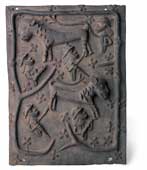 |
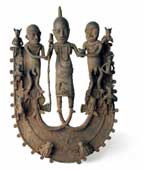
Cultural and stylistic mixtures are not rare in Benin. Foreign influences have shaped Benin over centuries and have found expression in its culture. A very prominent example is the representation of Portuguese men, which were considered worth to be depicted and found their way into the bronzes, in the case of the Berlin exhibition as leopard hunters, in a background medallion and even as motive of many textile patterns. That the Benin culture was also influenced by the neighbouring countries shows a frieze with an Oba (king of Benin) whose feet end as bowfin [amiidae; only to be found in North America nowadays] or catfishes [malapteruridae; native to South America and Africa]. His face and those of the two persons who support him stylistically still refer to Benin. |
|---|
A standing bronze sculpture with a cross in front of its chest, scars in the form of cats' whiskers at the corners, and a hat stylistically is clearly Benin; though it also shows strange and unusual elements. Scars in the form of cats' whiskers and the cross are not typical for Benin. Especially the scars refer to a stranger. This sculpture wears a [loincloth/grass skirt], the torso rests bare and is decorated with two chains, only, apart from the cross. In the right hand it holds a hook or a curved stick, and in the left one a kind of an axe or a hammer. The meaning of this standing male figure is mysterious and provokes numerous theories and assumptions. Such scars are typical for some tribes, e.g. for the Nupe, which live to the north of the Yoruba. But they can also be seen on old Ife terracottas what leads Franc Willett to the assumption they might be Ife people, which might have had the function of messengers between the two royal cities. |
 |
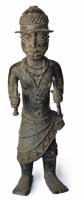 |
This theory is supported by the tradition by a Portuguese man at the end of the 15 th century. He also reports of a messenger of the king, who is said to have brought the symbols of authority (hat, chest cross, stick) from Ife to Benin in order to thus confirm the new king of Benin. Having successfully finished his mission, the messenger as a former slave is said to have received a cross himself as a sign of his newly retrieved freedom. Already 1919, Felix von Luschan tries to prove that this figure represents a king named "Panther". In this case the representation of the whiskers was not to be understood materially, but only symbolically. He interprets the cross around the neck as a Christ order attributed by Portugal. Meanwhile, his theory is considered as outdated, and is hardly any more discussed.
Recent researchers as Paula Ben Amos suggest a completely different interpretation of this object. According to her theory it represents either a priest of Osanobua, the creator God, or a member of the secret "Ewua association". Both groups are said to have worn crosses at court. Then, the cross would be a cosmogonic symbol and refer to the creation of the world. |
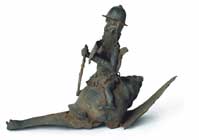
While this type can regularly be found in different modifications in Benin art, another subject cannot be found in literature and is therefore still more mysterious - the warrior on the snail. He is decorated with coral necklaces, which is typical for members of the royal court. About the meaning of the snail can only be speculated. Since animals usually are closely related to myths, a connection with the myth about the establishment of the dynasty written down by the Benin chronicler Egharevba (1893-1980) might be given: The God Osanobua sent his sons to
live on earth. Each of them should take with him something useful for the journey. While the elder sons chose talents such as magic or wealth, the youngest one took a snail shell on recommendation of a bird. |
 |
|
When the sons arrived on earth, they realized that the talents magic and wealth useful in heaven were useless on earth, because the whole surface of the earth was flooded and therefore uninhabitable. The bird instructed the junior to turn round the snail shell, and an endless quantity of sand poured out of it, which made him lord of an enormous piece of land. Thus the youngest son became ruler of the world. Possibly, the object represents the youngest son of Osanobua proudly sitting or riding on his useful shell, who hereafter became founder of the realm of Benin. Without doubt, the Benin man and chronicler of Benin, Egharevba, has enormously contributed to the cultural memory of the ancient Western African kingdom of Benin by noting old myths and legends - many of them told by his grandmother. It is problematic for many interpretations that his historical recordings often are not reflected, and reproduced as "facts ". Finally, his point of view can hardly be proved as incorrect by someone who is a stranger to the culture. An example in the exhibition illustrates the fact that also the data of a chronicler from Benin must be analyzed. Already because of its function the by far over life size big head with wing-like head decoration is very special. While most other bronzes were made for representation purposes, this one, as also the female counterparts with coral hats, was used for religious rituals. In literature estimations of the age of these heads refer in uncritical repetition almost exclusively to Egharevbas remarks. Accordingly, the representation of rulers of Benin with wing-like head decoration would have been introduced by Oba Osemwede (1816-46), and therefore be at maximum 190 years old. In the exhibition an identical winged head is estimated 450 years old by the TL method. Additionally, stylistically similar heads without wings - which seem to originate from the same workshop - are regularly estimated more than 250 years old in literature. How is it possible? If all these objections were scientifically examined, Egharevbas statement would also have to be partly corrected. Much about the bronzes is in the dark, little is clarified. Often, neither concrete data concerning the age nor the context are known in which the objects were created - from allocation over foundry workshops to individual persons. The acknowledgement of a large number of objects, which circulate on the market like the bronzes of the exhibition, apart from the already recognized objects, would offer unknown possibilities, e.g. for style comparisons. Even if one cannot always get facts which are at 100 percent certain, one can exclude step by step much which is illogic and thus gain new knowledge, as the examples of the sitting female or the Ibo hair-style have shown. |
Columns |