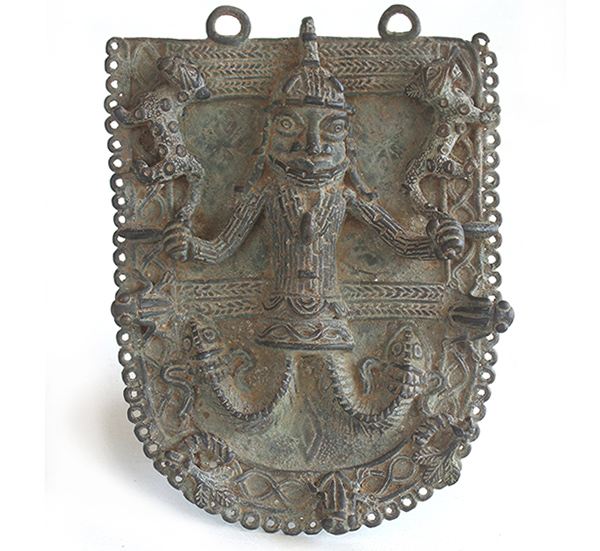
A cast piece, skilfully crafted both artistically and technically, produced to be hung up. The motif commemorates King Ohen, who lived in the 14th century and, after his legs became paralysed, declared that he had been transformed into the sea god Olokun.
Clearly, his existence is linked to significant mythological interpretations, as the motif has been subject to a wide range of interpretations right up to the present day. You can see one such interpretation on the ‘Gallery’ page, which we exhibited in 2007 alongside a text by Dorina Hecht entitled ‘Relief Panel with Oba and Companion’. There, she refers to Felix von Luschan, who, in the context of the legs, speaks of a historical connection to the trembling catfish Malapterurus. A predatory fish native to the inland waters of West Africa. Both legs are depicted as fish.
The figure’s importance is emphasised by a richly embroidered coral shirt, which has long sleeves reaching down to the hands, thereby highlighting the figure’s immense wealth. The necklace and the large collar—typical of Benin, extending from the chin to the mouth—are also made of red coral. The brim of the hat is likewise adorned with coral. The skirt is depicted with thick braided borders, which are repeated in the background behind the figure on the plaque.
These decorations are currently, in the mid-1920s, the subject of ethnological research. It is believed that the age of the artefacts can be determined by detailed characteristics. This is an endeavour which Peter Herrmann views with some scepticism, as no comparative laboratory results are accepted and clear craftsmanship flaws from particular periods are classified as distinctive features. Such research has already been proven incorrect by the gallery in relation to other attempts to analyse motifs.
In addition to his elaborate clothing, Oba Ohen holds the tail of a leopard in each hand; in the countryside, this predator symbolically holds the same significance as the electric catfish in the water. Both leopards serve as border decorations, as do the three frogs pointing towards the water. On both sides of the edges, between the frog and the leopard, there are small, elongated objects which cannot be interpreted, but which, given their position, are intended to convey a certain meaning. In the lower section, two curved forearms with hands are depicted symmetrically, holding a plant. This is a motif that has already been seen on other objects, and therefore has a special significance, though it cannot be described.
The small plaque, cast using the lost-wax method, shows no damage whatsoever and has an evenly matured patina. A few tiny air bubbles are almost invisible in insignificant places. A masterpiece from the 18th century
Cp.:
Frank WILLETT: Ife. Metropole afrikanischer Kunst, Bergisch Gladbach 1967.
Felix von LUSCHAN: Die Altertümer von Benin, Band 1, Berlin 1919, S. 93.
Barbara PLANKENSTEINER (Hg.): Benin. Könige und Rituale. Höfische Kunst aus Nigeria, Wien 2007, S. 391 - 393. |